
The Wake Below
A compiled record of what moves beneath Cayuga Lake.

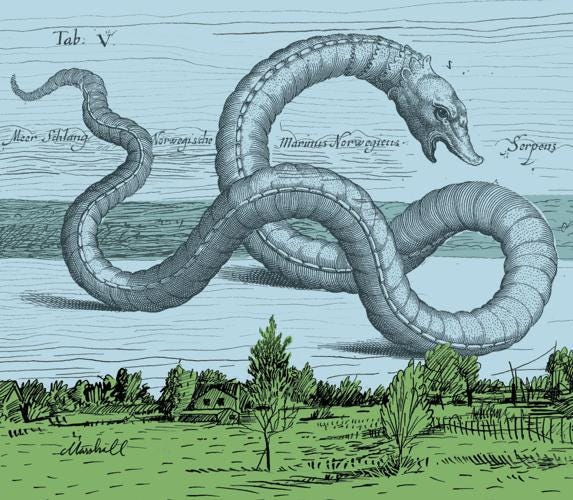
Ruth
Ruth runs the last dinner cruise across Cayuga Lake the same way she always has—by routine, by instruments, and by checking anything that doesn’t match either of them.
It’s July 4th weekend. The faint smell of hot dogs and burgers on the grill mingles with the sulfuric tang of fireworks. The air is still warm but the lake has started to cool enough that a patchy fog hangs low over the water. The boat is about half full. Groups of tourists tipsy from day drinking at the wineries, a few couples with kids, a handful of repeat local customers that Ruth greeted with a slight nod of her head.
Everything feels normal. Maybe a bit more festive because of the holiday, but not out of the ordinary.
Halfway across, Ruth notices something off the port side. She squints, leaning forward over the helm. It’s a darkening under the surface that keeps pace with the ferry.
At first she assumes it’s a current shift or wake reflection from the hull. Maybe debris dragged up from deeper water. Cayuga is deep enough in places that things can rise and disappear without ever being seen clearly.
But it doesn’t behave like either of those.
It stays with the boat.
Same speed. Same position. Just under the surface, close enough that she should be able to lose it if she changes course slightly—but when she adjusts the throttle, it adjusts with her.
Ruth slows the ferry a fraction more than she normally would, until they’re barely moving at all. The passengers don’t notice. They’re all looking the other way, phones out, talking over each other.
The shape holds for nearly a full minute.
Then it drops away.
Ruth keeps the ferry steady, bobbing ever so slightly on the surface, and watches the spot until it’s behind them.
She doesn’t call it in. There’s nothing to report that won’t sound like weather, reflection, or fatigue. Instead, she opens the logbook and writes: possible debris or optical distortion.
Then she closes it and keeps the boat on course.
ARCHIVAL INSERT—Ithaca Daily Journal, January 5, 1897
SEA SERPENT REPORTED FOR SIXTY-NINTH CONSECUTIVE YEAR
Residents along the eastern shore of Cayuga Lake again report the appearance of the creature locally known as “Old Greeny.” According to one Ithaca resident traveling by carriage near the lakeshore road, the object observed beneath the water was “a large, long sea serpent moving just below the surface.”
Members of the Ithaca Journal staff note that sightings have occurred in each of the past sixty-nine years, leading to what some describe as routine anticipation of the creature’s return. Several reporters have declined assignments requiring travel near the lake.
A laborer interviewed at the scene suggested the object was likely a muskrat observed under unusual lighting conditions. No physical evidence was recovered.
Ruth
Ruth does not go looking for the dive crew’s livestream. It appears in the recommended feed between maintenance updates and weather alerts: “LIVE DIVE — CAYUGA LAKE WRECK IDENTIFICATION.”
She’d heard about this at the marina. Some crew of Cornell kids, inspired by the 2013 canal boat discovery near Aurora, had taken to plumbing Cayuga’s depths, hoping to coax the lake into surrendering more of its long-forgotten tragedies. Maybe they wanted to outdo not only the canal boat find, but the infamous 1907 steamboat fire as well.
Lots of folks—Ruth included—just shook their heads. Rich kids with too much time on their hands. Weren’t going to find all that much that hadn’t already been found and documented.
And yet, this livestream is proof otherwise.
At some point, the divers switched on underwater lights turning the pitch black of 300 feet of water neon green. A submerged structure half-buried in sediment filled the screen. The divers move slowly, brushing away silt, measuring and marking fragments of timber and iron fittings consistent with an old transport vessel.
In their excitement, they must have forgotten to hold the camera steady and the camera drifted slightly off target.
Something passed behind the divers in the haze of disturbed water. It is not fully visible, but large enough that the water around it shimmered and bubbled with displacement. The shape did not linger long enough to be interpreted cleanly, but it moves with a sharpness and precision of something other than debris.
And it was fast. In and out of frame within a literal blink of an eye.
The comments begin to argue almost immediately about compression artifacts and visibility conditions. The divers continue working as if nothing happened.
But the footage ends abruptly about twenty minutes later, cutting off the comments mid-sentence, when one of the safety lines goes slack.
ARCHIVAL INSERT—Steamboat Encounter, Seneca Lake, July 14, 1899
Geneva Gazette — Special Dispatch
The steamboat Otetiani, en route north toward Geneva, encountered an unidentified object approximately 400 yards ahead, initially believed to be an overturned vessel. Captain Carleton Herendeen ordered a reduction in speed to investigate.
Upon closer approach, passengers observed a dark object estimated between 25 and 90 feet in length. As the vessel neared, multiple witnesses reported the object turned toward the steamboat and raised its head above the surface, revealing what were described as “two rows of sharp white teeth.”
The captain ordered an attempt to intercept the object. The steamboat struck the target at speed, producing a violent impact that threw several passengers off balance. The object reportedly sank immediately afterward and was not recovered, despite attempts to secure it.
Accounts differ significantly regarding its exact size and appearance.
Ruth
The diver does not return.
The camera is recovered two days later by shoreline patrol and still contains partial footage, according to reports in the Ithaca Journal, though most of it degraded by water intrusion. What remains shows sediment clouds, shifting light, and brief glimpses of movement far below the wreck site that never resolves into anything stable enough to identify.
Ruth can’t stop thinking about the flick of a shadow in the video.
ARCHIVAL INSERT — Field Report, Cayuga Lake Eastern Shore, 1929
Reports have circulated intermittently in recent years describing a large unidentified aquatic form in Cayuga Lake. These accounts remain unverified and are generally attributed to misidentification of known fish species or floating debris.
In June 1929, The Ithaca Journal published a brief item reporting that two such “sea serpents” were said to have been observed in Cayuga waters.
During shoreline observation south of Aurora, two independent witnesses reported seeing two elongated dark forms just beneath the surface, moving parallel to one another along the eastern shore. Both estimated the length of each form at approximately twelve to fifteen feet. Descriptions of thickness varied, with one witness comparing it to “a large log,” and another stating it appeared “thicker than a rowboat.”
One observer described the motion as coordinated, “as if the two were following each other.”
The newspaper report repeated local speculation that earlier sightings of a single creature may have involved multiple animals, or varying partial views of the same forms under changing light and water conditions.
The same report referenced a popular local theory suggesting a connection between Cayuga and Seneca Lakes via an underground passage, proposed as a possible route of movement between reported sightings in the two lakes. This remains unverified and unsupported by geological survey work conducted in the region.
No photographs or physical specimens were obtained during the observation period.
All accounts remain anecdotal.
Ruth
She started building a map out of historical records, marking an old marine chart with a red X every time a newspaper article or some other document mentions an anomaly. No matter how absurd the report she marked her chart. Every reported sighting fell into the same pattern of geography: deep channels, old wreck sites, storm corridors, and places where the lakebed has been disturbed either by natural forces or human activity.
It did not behave like a creature moving randomly through water. If it was a creature.
ARCHIVAL INSERT — Local Report, 1974
Tompkins County Health Department Incident File (Excerpt):
A juvenile male reported injury while swimming from a private dock on the eastern shore of Cayuga Lake. Witnesses describe the subject being pulled partially underwater by an unseen force. The subject sustained a fractured forearm.
No animal was observed in the area. Water conditions were described as briefly agitated despite calm weather and minimal wind activity.
The incident was closed due to insufficient evidence.
Ruth
She began comparing them against navigation records, Coast Guard incident reports, and dredging surveys. The older the data, the more consistent the overlap became. Even when the terminology changed—“capsizing,” “mechanical failure,” “loss of stability”—the locations did not shift. They repeated with a precision that made coincidence statistically impossible.
Still, she tried removing the most sensational entries. The pattern did not break. She removed the most unreliable witnesses next. It still held. When she overlaid modern sonar mapping from ferry maintenance logs, the same corridors reappeared beneath the updated grid lines, as if nothing about the lake’s internal structure had changed in a century of documentation.
The absence of recent sightings became its own anomaly. After 2011, the language changed. Reports still existed, but they flattened into technical summaries with no reference to anything in the water. Equipment failure replaced contact events. Weather replaced cause. Anything ambiguous was resolved upward into infrastructure or atmosphere by default.
Yet the accident locations did not redistribute. They stayed fixed to the same submerged routes.
ARCHIVAL INSERT — Recorded Interview Transcript, 1979
Interview Subject: Jack Marshall, owner/operator, J.T. Marshall Professional Diving Service
INTERVIEWER: Start again from when you first saw it.
MARSHALL: We were heading north across Cayuga. Just me and a couple buddies out on the boat. Nothing unusual. Lake was calm. Then I spotted what I thought was a damn tree floating dead ahead of us. Big one, too. I yelled for Tommy to cut the engines before we hit it. Boat drifted in closer after that. Maybe ten feet off. Close enough to really look at it. And that’s when we realized it wasn’t a log.
INTERVIEWER: What did you think it was?
MARSHALL: I don’t know what I thought. Thing was long. Thirty, thirty-five feet at least. Maybe more. Dark green or black under the water. You couldn’t make out all of it at once because the lake was murky, but you could see the shape moving under the surface. Slow. Smooth. Didn’t thrash around like a fish. Didn’t dive like one either. It just slipped down under the boat like it knew we were there.
INTERVIEWER: Did you attempt to follow it?
MARSHALL: Absolutely not.
Ruth
Ruth chastised herself. This was a stupid idea. A really stupid idea based on what? A feeling? A feeling supported by what was likely the sliding of moonlight across the water and likely debris floating by an underwater camera.
But what if she was right? What better reason did she have to be out in her single engine skiff in the dead of the night if not monster hunting?
The late hour offered no reprieve from the late August humidity and her hair and shirt clung to her skin. Angry rain clouds had been accumulating all day. Both the weather app on her phone and the pressure in the air suggested the storm would break tonight. And if the historical logs were even loosely consistent, incidents attributed to “Old Greeny” tended to occur during such weather conditions.
Rain came down the lake, from the north end, in a wall of gray against the dark sky. She whipped up her rain jacket hood and hunched over the CHIRP sonar she’d borrowed from the marina. It’s ticks and clicks were barely audible over the hiss of the rain as the storm blew into where she’d moored the skiff.
Tick. Tick.
There. Blue and green and moving fast. Then nothing. The sonar blinked out. Ruth whacked it with the palm of her hand, flicked the switch on and and off.
Then something struck the hull.
Not impact in the way of floating debris or another vessel. It was deliberate, precise contact. More of a push than a ram. Enough to move the skiff slightly off line in the water.
Ruth froze with her hand still on the CHIRP.
Another contact followed, this time along the underside. Slow. Controlled. The hull answered it with a low, uneven vibration that traveled up through the deck and into her feet.
She killed the engine.
Ruth leaned over the side of the boat. Slowly at first, then further, gripping the rail hard enough that her knuckles lost color. She squinted into black water. Lightning broke open the sky long enough to flatten the lake into a single illuminated surface.
For a fraction of a second, she saw it twisting over and around itself in rhythm with the undulating waves.
Then the lightning died and the lake went black again.
Ruth stayed leaning over the rail, breathing shallowly, rain ticking against the hood of her jacket.
Another flash tore across the clouds.
Something long and dark rolled just beneath the surface beside the skiff. She caught the suggestion of ridged skin slick with water, a curve of a body thick enough to overturn the boat without effort.
Then an eye opened.
Gold. Vertical pupil. Snake-like. Fixed directly on her.
Ruth stopped breathing.
The thing held there for one impossible second, half-submerged beneath the rain-churned surface.
Then it rose.
The head emerged first, water pouring from it in sheets. Long. Serpentine. The jawline too large, too heavy. More body followed behind it in a dark curve that disappeared back into the lake before she could find where it ended.
Its mouth opened just slowly enough for her to see rows of pale, inward-hooking teeth behind curtains of lake water.
Her hand slipped off the rail and Ruth stumbled backward so hard the skiff rocked beneath her feet. She hit the console, fumbled for the ignition keys, missed them once, then again with numb wet fingers.
The serpent surged closer.
Ruth jammed the key into the ignition and turned.
AFTER
By morning, everything had returned to acceptable explanations. Wind shear. Optical distortion. Misidentification under stress. The footage from the dive crew forgotten.
Ruth does not argue with any of it. There is no argument to be made that changes what she saw.
The lake is calm again when she runs the next dinner cruise. The passengers are relaxed, talking about wineries and weather forecasts, already forgetting what the water looked like the night before.
Ruth stands at the rail during the midpoint of the crossing and looks down into the dark. For a long time, nothing appears. There is only the movement of the lake against itself. Wind pushes one direction. Current pulls another. The ship continues forward through both.
Then something changes beneath the surface.
Ruth stays still.
The shape never fully appears. She catches only fragments of it between reflected lights and black water: a long curve below the surface, then nothing, then movement again farther down the length of the ship as though something immense is traveling beneath them in parallel.
Not approaching nor retreating, simply keeping pace as it continued along the same unseen corridors it has always occupied.
Author’s Note:
This story is a work of fiction. Whether Old Greeny is also a work of fiction is up for debate. I have woven together the legend of Old Greeny with the supposed encounters with the cryptid. While the archival poritons of the story are of my own telling, they are representative of the moments Old Greeny has made himself (herself?) known.
Old Greeny is a local legend of the Finger Lakes area of New York (residing specifically in Cayuga Lake) that, if I’m honest, when I first started researching I thought was relatively new invention. I certainly had never heard of Old Greeny—at least not by name—growing up. None of the articles mentioned in the publications I read actually exist. I tried to find, specifically, the January 5, 1897 Ithaca Journal article and while I was able to find what I believe is the digitally archived paper with that date and year, it does not contain a single article mentioning Old Greeny. Most of the articles and videos I found is from the early 2000s.
Then I discovered this tidbit on The Cryptid Wiki and something kind of for me:
One of the last known documented encounters with Old Greeny occurred in 1979 while Jack Marshall, owner of J.T. Marshall Professional Diving Service, was boating with some friends on Cayuga Lake. While cruising the lake Marshall saw what he believed at the time to be a large fallen tree directly in the path of his boat. He shouted back to the driver of the boat to cut the engines and stop before the boat collided with it. As the vessel slowly drifted to a stop a few feet from the log the group realized that it wasn’t a log at all, but a 30 to 35 foot long living creature which slowly slipped below the surface before their eyes.
Jack Marshall is a friend and neighbor of my grandparents. He indeed owns a dive shop. When I was a kid, Mr. Marshall used to try to scare my sisters and I by teasing that the lake monster would get us. Little did I know he’d encountered the real thing!
Like any good legend, there are theories about what Old Greeny could be. There is a strong likelihood that Old Greeny—in it’s various incarnations through the 1800s to 2011—was a series of sturgeons. Sturgeons are huge. They can get up to 6+ feet long and weigh hundreds of pounds. I imagine that if you see a few of those in one spot and/or after having imbibed in one too many glasses of our famed wine, it could be some-what frightening. It is plausible that such a fish, if it had the mind to, could latch onto and break a child’s arm.
But how to explain away the thirty to thirty-five foot creature that Jack Marshall and friends saw on the lake? Did they collectively hallucinate Old Greeny?
Maybe Old Greeny is a brilliant marketing ploy to sell tickets to the Old Greeny Fringe Fest.
Or, is it entirely possible that Cayuga Lake, the longest and deepest lake in the Finger Lakes region of New York, has it’s own secrets hidden within it’s depths?
Further Old Greeny Reading:
Here there be monsters: Diving into the legacy of the beasts of the Finger Lakes by Charley Githler (Ithaca Times).
Further Reading About Ship Wrecks on Cayuga Lake:
Mystery at the bottom of Cayuga Lake by Andrew Casler (Ithaca Journal)
The Frontenac (The Pomeroy Foundation—they place historical markers in NY)
Love this! And the family connection makes it even better.
This was awesome! How much research on boats and sonar did you do?