
Death Takes a Vacation
A burned-out Death takes a holiday aboard the Titanic.

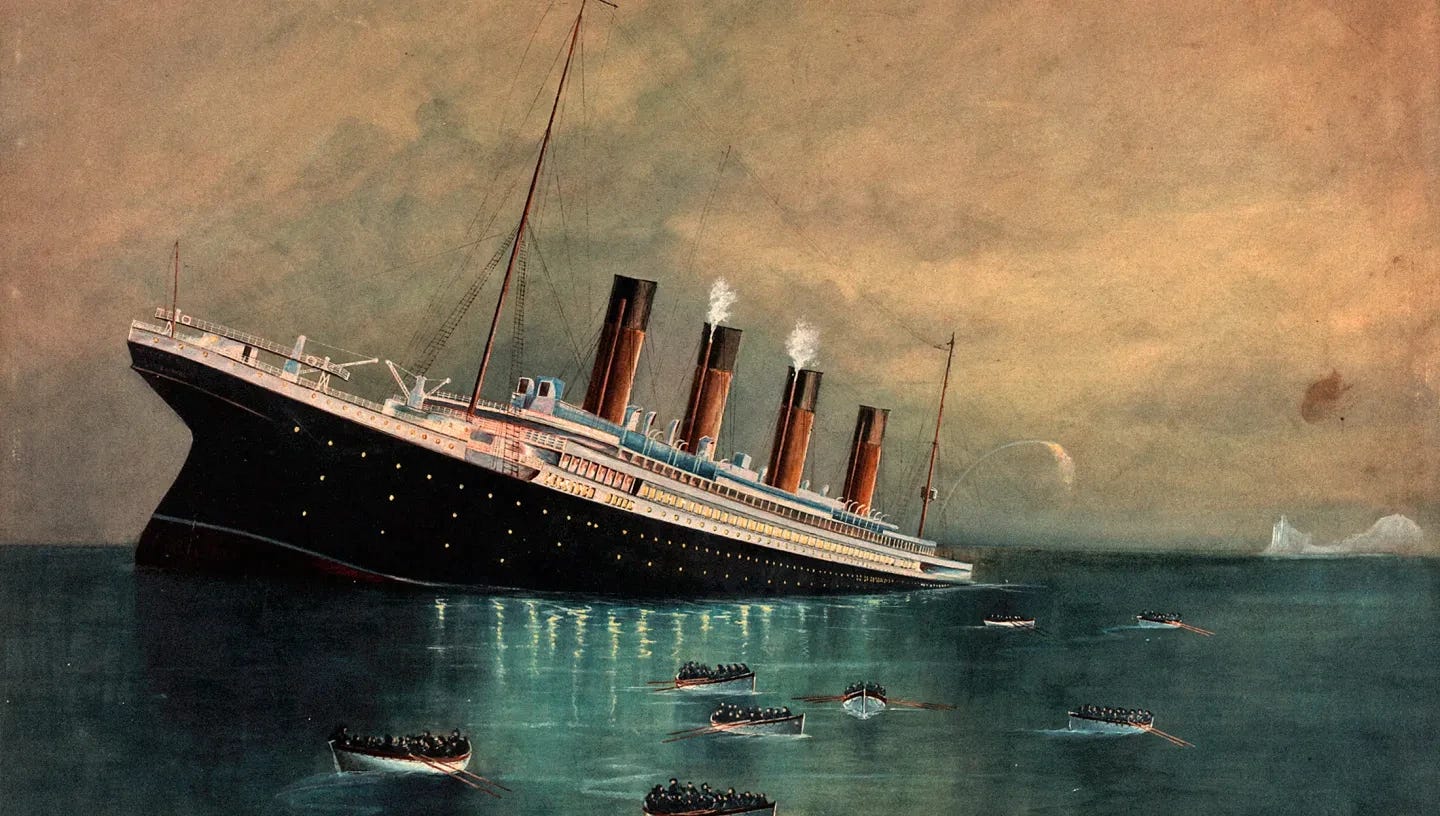
Death had not intended to take a vacation. It wasn’t, strictly speaking, in the job description. But after several thousand years of uninterrupted service—plagues, wars, unfortunate ladder incidents—Death decided that if no one else was going to approve the request, they would simply… take it.
Thus, under the name “Mr. Mortimer Graves’’ and in a skin suit resembling a man of little consequence, Death boarded the RMS Titanic with a single suitcase and absolutely no intention of collecting anyone for the seven days it took the newly minted World’s Largest Ship to sail from Southampton to New York City.
The first telegram found him lounging at the heated saltwater pool on F Deck. Mr. Graves found the ship-issued swimming singlet to be rather itchy. Death always had a slight allergy to wool, which is why he’d requested that all reaper robes be made of cotton centuries ago. Death was contemplating whether or not a trip to the Turkish spa’s masseuse would alleviate the desire to scratch when a white gloved hand presented a silver salver carrying a single slip of paper.
CALCUTTA—FEVER WARD OVERCAPACITY. NONE EXPIRED. STOP.
DISCREPANCY NOTED. ADVISE. STOP.
—ADMINISTRATION
Death crumpled up the telegram and tossed into a potted plant on the way out the door.
Another telegram arrived during the evening of the third day, while Mr. Graves was enjoying a most decadent dinner of oysters, salmon with hollandaise sauce, lamb with mint sauce, roasted chicken, and sirloin beef with horseradish. Death slid it into a jacket pocket and turned to the woman seated next to them for some polite conversations.
Mrs. Margaret Brown—“please call me Maggie, all my friends do!”—was a slightly brash American socialite returning from a tour of Europe and Egypt. She spoke as though silence were something mildly rude that ought to be corrected immediately.
“You know,” she said, leaning in conspiratorially, “this ship is supposed to be unsinkable.”
Mortimer Graves considered this. “That is an optimistic assessment of maritime engineering,” he said carefully.
Maggie laughed. “Oh, I like you. You’re dry.”
“I assure you,” he replied, “I am quite hydrated.”
She laughed heartily, head tilted back.
Death liked her immediately.
A second telegram arrived halfway through the soup course. Then a third before dessert. Graves did not open them.
By the end of the evening, he excused himself to the deck, where the air was colder and fogged his breath. Or would have if Death had lungs by which to inhale and exhale.
Death unfolded the latest message.
LONDON—DOCKSIDE COLLAPSE DURING LOAD-BEARING TESTS. NO FATALITIES. STOP.
ST. PETERSBURG—CIVIL DISTURBANCE CONTAINED WITHOUT EXECUTIONS OR LOSS. STOP.
GLOBAL BACKLOG ACCUMULATING BEYOND TOLERANCE. STOP.
THIS IS NOT SUSTAINABLE. STOP.
—ADMINISTRATION
Mr. Graves spent the fourth day on the Titanic in a game of hide-n-seek from the man with the white glove and silver tray. And yet the telegrams found him. One after another after another until Death began to worry that the constant deluge would draw attention to the unassuming Mr. Graves in a manner most unbecoming.
And so, with a heavy heart, Death opened the last telegram.
GLOBAL MORTALITY BALANCE CRITICAL. STOP.
UNRESOLVED CASES ACCUMULATING ACROSS ALL JURISDICTIONS. STOP.
IMMEDIATE CORRECTION REQUIRED TO PREVENT SYSTEM OVERFLOW. STOP.
THIS IS NO LONGER ADVISORY. STOP. THIS IS COMPULSORY. STOP.
—ADMINISTRATION
Mortimer Graves returned to his cabin as the night deepened over the RMS Titanic. The telegrams had stopped arriving. That, in itself, was never a good sign.
He sat for a moment beside the neatly made bed and considered his suitcase. Packing would imply departure. Packing would imply Mr. Graves had somewhere else to be.“No,” he said quietly. “That simply cannot be.”
Mr. Graves would go down with the ship.
Death walked the length of the ship listening and probing. The flaws in the design weren’t visible to the human eye. The cold waters of the North Atlantic Ocean had put strain on the low-cost rivets that the ship builders had installed–a cost saving measure that would cost lives. The steel of the hull had also turned brittle, inflexible, in the ice-filled waters. And the low-topped watertight bulkheads were a critical design flaw that would allow water to overflow from one compartment to the next, helping to draw the ship down.
Death touched each of these places with a skeletal hand. Using both hands, Death reached out and pushed an iceberg directly into the path of the Titanic.
The unsinkable ship would sink. Many of her passengers and crew would die in the frozen waters. All would be right again.
Later, once again in the Mr. Graves skin suit, Death watched as chaos erupted. Maggie Brown found him near the rail.
“Mr. Graves!” she called, as though they were still discussing dinner. “You look like a man who knows what’s happening.”
“I am afraid I do,” he said.
“Well?” she asked, breathless but still somehow conversational. “Is it bad?”
He considered the question.
“Yes,” he said. “Thoroughly.”
She laughed once, sharp and disbelieving. “Well, that’s… comforting in its way.”
It was not, but he appreciated the attempt.
When the time came to choose, he did not need to deliberate. She had made him laugh once. That was, in his current mood, an extraordinary kindness.
He guided her toward a lifeboat. Not all kindnesses needed explanation.
Some day, they would call her The Unsinkable Molly Brown. Where they’d get Molly from—her friends called her Maggie—was beyond Death.
After the ship had cracked, breaking into two pieces, he walked among the dead and dying. Some, perhaps thinking themselves lucky to grab life preserver, bobbed up and down like corks in the frigid waters. Death touched their shoulders and stroked their hair, easing their passing. Others clung to whatever flotsam they could find.
Death paused, ever so briefly, besides a young couple. She on a door, him clinging to the floating portal. Death wanted to hoist this young man out of the water and to safety next to the young women—there was room enough for two!—but instead touched the young man on the forehead. His heart stopped.
When it was done, he stood for a moment longer, listening to the Atlantic return to its usual silence as the shouts for help grew fainter and fainter.
Death sighed.
“I didn’t even finish my holiday.”
Some details in this work of fiction are fact including the pool and Turkish spa on F Deck, the menu, Mrs. Margaret Brown (aka The Unsinkable Molly Brown), and the structural flaws that existed in the Titanic’s hull and design. The telegrams also refer to some events happening elsewhere in the world at the time as well.
This story was written for Bradley Ramsey’s Day 2 Prompt for The Halls of Pandemonium. Read the other stories here!
I love the mix of truth and fiction, and the consequences of death taking a holiday!
Poor Death. Does Death work on commission, hourly, or salary? Like a superhero, no vaca. Just wanted a voyage.